Model verification
In this notebook the model is verified by comparing outcomes of two different examples.
[1]:
import pandas as pd
import networkx as nx
import matplotlib.pyplot as plt
import numpy as np
[2]:
from context import RiverNetwork
from RiverNetwork import RiverNetwork
---------------------------------------------------------------------------
ModuleNotFoundError                       Traceback (most recent call last)
<ipython-input-2-34661278ac7e> in <module>
----> 1 from context import RiverNetwork
      2 from RiverNetwork import RiverNetwork

~/checkouts/readthedocs.org/user_builds/rna/checkouts/stable/docs/context.py in <module>
      5 sys.path.insert(0, os.path.abspath(os.path.join(os.path.dirname(__file__), '..')))
      6
----> 7 import RiverNetwork
      8 import fit_muskingum

ModuleNotFoundError: No module named 'RiverNetwork'
[3]:
%load_ext autoreload
%autoreload 2
University of Colorado Boulder example
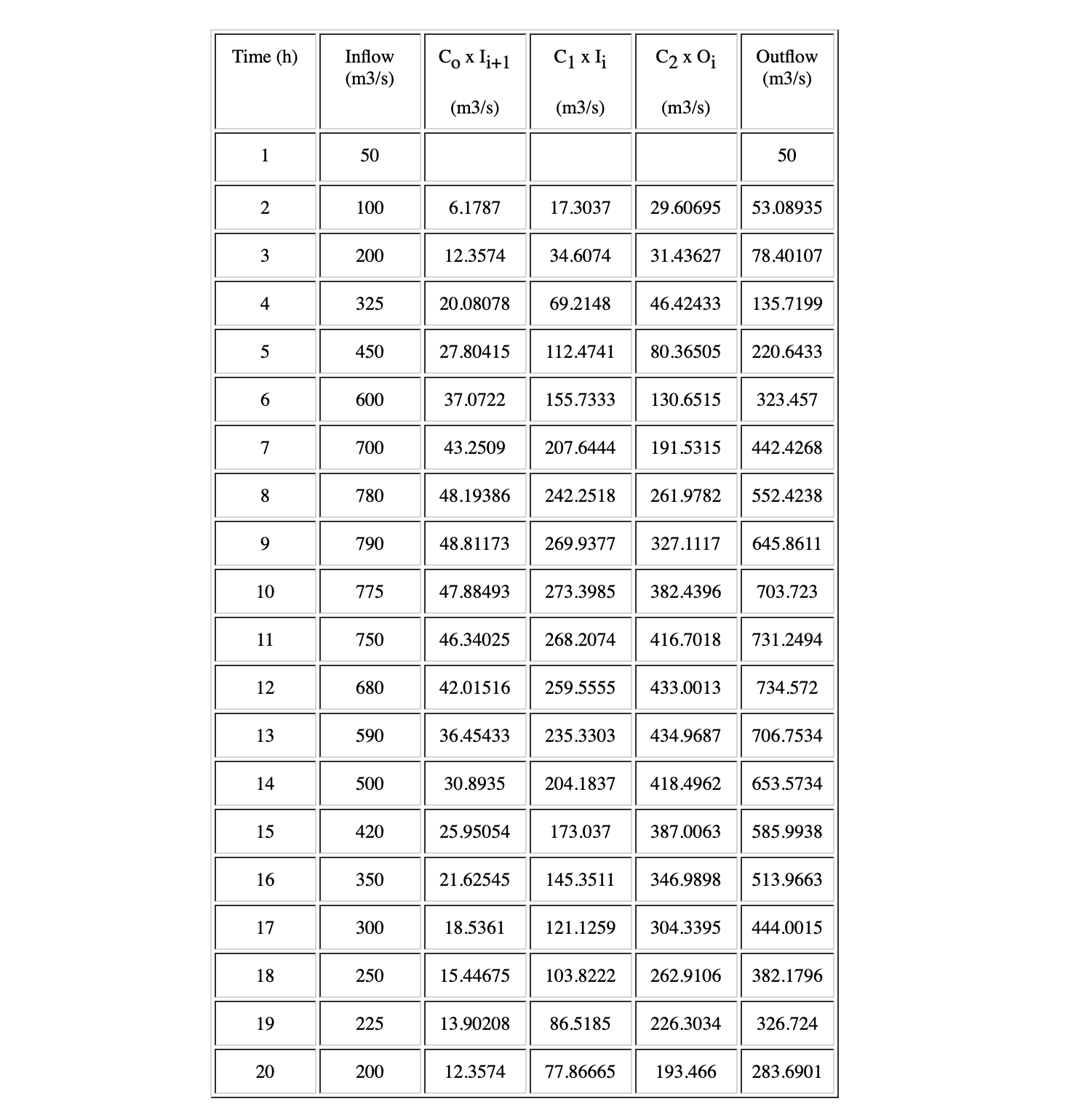
This is the most straightforward example that I could find. It is a simple one segment model. \(k\) and \(x\) are estimated to 2.3h and 0.151559154 respectively.
Loading data
The structure is loaded as well as the inflow. On the graph we can see the correct \(k\) and \(x\)
[4]:
structure1 = RiverNetwork('../data/single-segment-boulder.xlsx')
structure1.draw(figsize=(3,3))
---------------------------------------------------------------------------
NameError                                 Traceback (most recent call last)
<ipython-input-4-c29742f10cc0> in <module>
----> 1 structure1 = RiverNetwork('../data/single-segment-boulder.xlsx')
      2 structure1.draw(figsize=(3,3))

NameError: name 'RiverNetwork' is not defined
[5]:
inflow = np.array(pd.read_excel('../data/example-inflow-boulder.xlsx').Inflow)
structure1.set_shape('S.1',21,inflow-50)
structure1.draw_Qin(only_sources=True,figsize=(7,4))
---------------------------------------------------------------------------
FileNotFoundError                         Traceback (most recent call last)
<ipython-input-5-f57a4227e509> in <module>
----> 1 inflow = np.array(pd.read_excel('../data/example-inflow-boulder.xlsx').Inflow)
      2 structure1.set_shape('S.1',21,inflow-50)
      3 structure1.draw_Qin(only_sources=True,figsize=(7,4))

~/checkouts/readthedocs.org/user_builds/rna/envs/stable/lib/python3.7/site-packages/pandas/util/_decorators.py in wrapper(*args, **kwargs)
    206                 else:
    207                     kwargs[new_arg_name] = new_arg_value
--> 208             return func(*args, **kwargs)
    209
    210         return wrapper

~/checkouts/readthedocs.org/user_builds/rna/envs/stable/lib/python3.7/site-packages/pandas/io/excel/_base.py in read_excel(io, sheet_name, header, names, index_col, usecols, squeeze, dtype, engine, converters, true_values, false_values, skiprows, nrows, na_values, keep_default_na, verbose, parse_dates, date_parser, thousands, comment, skip_footer, skipfooter, convert_float, mangle_dupe_cols, **kwds)
    308
    309     if not isinstance(io, ExcelFile):
--> 310         io = ExcelFile(io, engine=engine)
    311     elif engine and engine != io.engine:
    312         raise ValueError(

~/checkouts/readthedocs.org/user_builds/rna/envs/stable/lib/python3.7/site-packages/pandas/io/excel/_base.py in __init__(self, io, engine)
    817         self._io = _stringify_path(io)
    818
--> 819         self._reader = self._engines[engine](self._io)
    820
    821     def __fspath__(self):

~/checkouts/readthedocs.org/user_builds/rna/envs/stable/lib/python3.7/site-packages/pandas/io/excel/_xlrd.py in __init__(self, filepath_or_buffer)
     19         err_msg = "Install xlrd >= 1.0.0 for Excel support"
     20         import_optional_dependency("xlrd", extra=err_msg)
---> 21         super().__init__(filepath_or_buffer)
     22
     23     @property

~/checkouts/readthedocs.org/user_builds/rna/envs/stable/lib/python3.7/site-packages/pandas/io/excel/_base.py in __init__(self, filepath_or_buffer)
    357             self.book = self.load_workbook(filepath_or_buffer)
    358         elif isinstance(filepath_or_buffer, str):
--> 359             self.book = self.load_workbook(filepath_or_buffer)
    360         else:
    361             raise ValueError(

~/checkouts/readthedocs.org/user_builds/rna/envs/stable/lib/python3.7/site-packages/pandas/io/excel/_xlrd.py in load_workbook(self, filepath_or_buffer)
     34             return open_workbook(file_contents=data)
     35         else:
---> 36             return open_workbook(filepath_or_buffer)
     37
     38     @property

~/checkouts/readthedocs.org/user_builds/rna/envs/stable/lib/python3.7/site-packages/xlrd/__init__.py in open_workbook(filename, logfile, verbosity, use_mmap, file_contents, encoding_override, formatting_info, on_demand, ragged_rows)
    109     else:
    110         filename = os.path.expanduser(filename)
--> 111         with open(filename, "rb") as f:
    112             peek = f.read(peeksz)
    113     if peek == b"PK\x03\x04": # a ZIP file

FileNotFoundError: [Errno 2] No such file or directory: '../data/example-inflow-boulder.xlsx'
Results of flow propagation
The flow is calculated for the sink node.
[6]:
structure1.calc_flow_propagation(20)
structure1.draw_Qin(figsize=(7,5))
---------------------------------------------------------------------------
NameError                                 Traceback (most recent call last)
<ipython-input-6-36d5c8e4a142> in <module>
----> 1 structure1.calc_flow_propagation(20)
      2 structure1.draw_Qin(figsize=(7,5))

NameError: name 'structure1' is not defined
Inflow for node S.1
[7]:
print(structure1.get_Graph().nodes['S.1']['Qin'])
---------------------------------------------------------------------------
NameError                                 Traceback (most recent call last)
<ipython-input-7-d7c00ee74e2c> in <module>
----> 1 print(structure1.get_Graph().nodes['S.1']['Qin'])

NameError: name 'structure1' is not defined
Inflow/outflow for sink E.1
[8]:
print(structure1.get_Graph().nodes['E.1']['Qin'])
---------------------------------------------------------------------------
NameError                                 Traceback (most recent call last)
<ipython-input-8-f5b40c22ed76> in <module>
----> 1 print(structure1.get_Graph().nodes['E.1']['Qin'])

NameError: name 'structure1' is not defined
These results are then compared to the results of the webpage. The figure shows that the results are almost similar. The small differences in outflow can be explained by rounding errors.
Karahan example
In this example the Wilson dataset from the Karahan paper is used. Karahan compared different estimation techniques. It is a simple one segment model. The most interesting difference here is that \(\Delta t\) is not 1 but karahan uses a value of 6. For this dataset the \(x\) is estimated on 0.021 and \(k\) to 29.165. This can also be seen in the figure. The base load is set to 22.
https://onlinelibrary.wiley.com/doi/full/10.1002/cae.20394
Loading data
[9]:
structure2 = RiverNetwork('../data/single-segment-karahan.xlsx',dt=6)
structure2.draw(figsize=(3,3))
---------------------------------------------------------------------------
NameError                                 Traceback (most recent call last)
<ipython-input-9-ed79ac5bd5f7> in <module>
----> 1 structure2 = RiverNetwork('../data/single-segment-karahan.xlsx',dt=6)
      2 structure2.draw(figsize=(3,3))

NameError: name 'RiverNetwork' is not defined
[10]:
inflow = np.array(pd.read_excel('../data/example-inflow-karahan.xlsx').Inflow)
structure2.set_shape('S.1',21,inflow-22)
structure2.draw_Qin(only_sources=True,figsize=(7,4))
---------------------------------------------------------------------------
FileNotFoundError                         Traceback (most recent call last)
<ipython-input-10-b870641c8db8> in <module>
----> 1 inflow = np.array(pd.read_excel('../data/example-inflow-karahan.xlsx').Inflow)
      2 structure2.set_shape('S.1',21,inflow-22)
      3 structure2.draw_Qin(only_sources=True,figsize=(7,4))

~/checkouts/readthedocs.org/user_builds/rna/envs/stable/lib/python3.7/site-packages/pandas/util/_decorators.py in wrapper(*args, **kwargs)
    206                 else:
    207                     kwargs[new_arg_name] = new_arg_value
--> 208             return func(*args, **kwargs)
    209
    210         return wrapper

~/checkouts/readthedocs.org/user_builds/rna/envs/stable/lib/python3.7/site-packages/pandas/io/excel/_base.py in read_excel(io, sheet_name, header, names, index_col, usecols, squeeze, dtype, engine, converters, true_values, false_values, skiprows, nrows, na_values, keep_default_na, verbose, parse_dates, date_parser, thousands, comment, skip_footer, skipfooter, convert_float, mangle_dupe_cols, **kwds)
    308
    309     if not isinstance(io, ExcelFile):
--> 310         io = ExcelFile(io, engine=engine)
    311     elif engine and engine != io.engine:
    312         raise ValueError(

~/checkouts/readthedocs.org/user_builds/rna/envs/stable/lib/python3.7/site-packages/pandas/io/excel/_base.py in __init__(self, io, engine)
    817         self._io = _stringify_path(io)
    818
--> 819         self._reader = self._engines[engine](self._io)
    820
    821     def __fspath__(self):

~/checkouts/readthedocs.org/user_builds/rna/envs/stable/lib/python3.7/site-packages/pandas/io/excel/_xlrd.py in __init__(self, filepath_or_buffer)
     19         err_msg = "Install xlrd >= 1.0.0 for Excel support"
     20         import_optional_dependency("xlrd", extra=err_msg)
---> 21         super().__init__(filepath_or_buffer)
     22
     23     @property

~/checkouts/readthedocs.org/user_builds/rna/envs/stable/lib/python3.7/site-packages/pandas/io/excel/_base.py in __init__(self, filepath_or_buffer)
    357             self.book = self.load_workbook(filepath_or_buffer)
    358         elif isinstance(filepath_or_buffer, str):
--> 359             self.book = self.load_workbook(filepath_or_buffer)
    360         else:
    361             raise ValueError(

~/checkouts/readthedocs.org/user_builds/rna/envs/stable/lib/python3.7/site-packages/pandas/io/excel/_xlrd.py in load_workbook(self, filepath_or_buffer)
     34             return open_workbook(file_contents=data)
     35         else:
---> 36             return open_workbook(filepath_or_buffer)
     37
     38     @property

~/checkouts/readthedocs.org/user_builds/rna/envs/stable/lib/python3.7/site-packages/xlrd/__init__.py in open_workbook(filename, logfile, verbosity, use_mmap, file_contents, encoding_override, formatting_info, on_demand, ragged_rows)
    109     else:
    110         filename = os.path.expanduser(filename)
--> 111         with open(filename, "rb") as f:
    112             peek = f.read(peeksz)
    113     if peek == b"PK\x03\x04": # a ZIP file

FileNotFoundError: [Errno 2] No such file or directory: '../data/example-inflow-karahan.xlsx'
Results of flow propagation
The flow is calculated for the sink node.
[11]:
structure2.calc_flow_propagation(22)
structure2.draw_Qin(figsize=(7,5))
---------------------------------------------------------------------------
NameError                                 Traceback (most recent call last)
<ipython-input-11-f4b55cfcc4cc> in <module>
----> 1 structure2.calc_flow_propagation(22)
      2 structure2.draw_Qin(figsize=(7,5))

NameError: name 'structure2' is not defined
The input and output data is shown:
Inflow for node S.1
[12]:
structure2.get_Graph().nodes['S.1']['Qin']
---------------------------------------------------------------------------
NameError                                 Traceback (most recent call last)
<ipython-input-12-53da6d4a19e4> in <module>
----> 1 structure2.get_Graph().nodes['S.1']['Qin']

NameError: name 'structure2' is not defined
Inflow/outflow for node E.1
[13]:
structure2.get_Graph().nodes['E.1']['Qin']
---------------------------------------------------------------------------
NameError                                 Traceback (most recent call last)
<ipython-input-13-055daccd658f> in <module>
----> 1 structure2.get_Graph().nodes['E.1']['Qin']

NameError: name 'structure2' is not defined
These results are compared to the results of Karahan. And as can be seen in the following figure, the output of the model is the same for Procedure II.
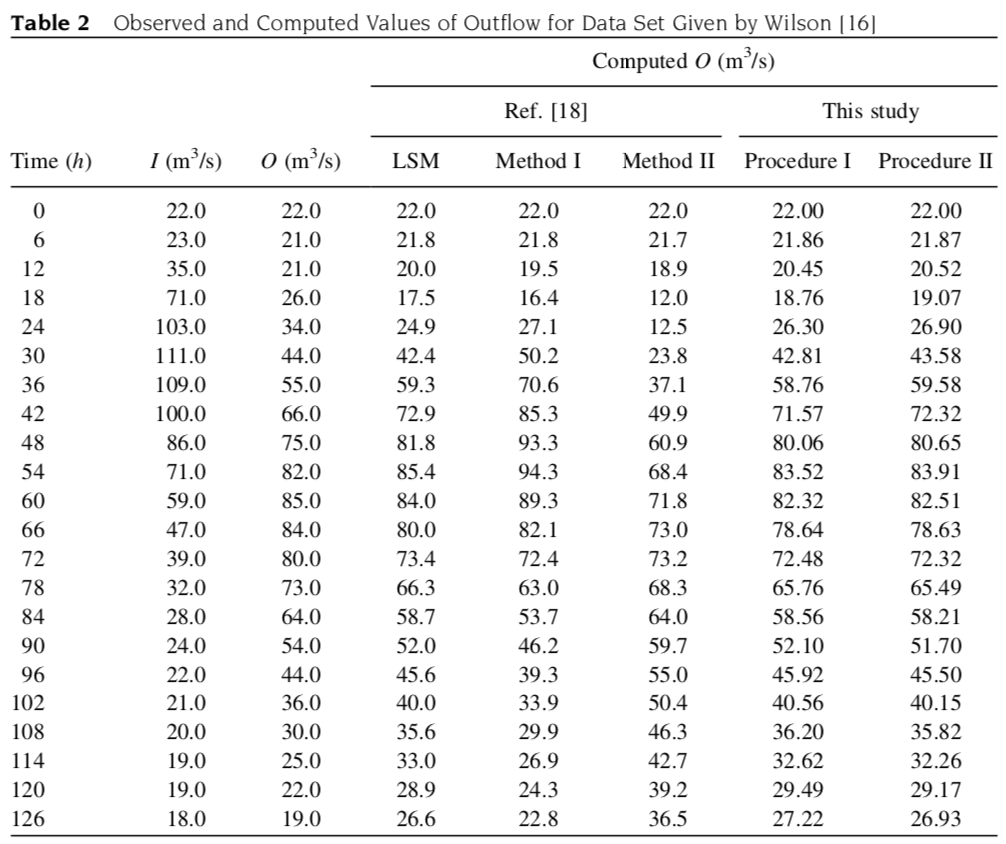
Karahan, H. (2012). Predicting Muskingum flood routing parameters using spreadsheets. Computer Applications in Engineering Education, 20(2), 280-286.
Warning
It should be noted that Karahan seems to use an invalid value for \(\Delta t = 6\). According to theory, the minimum value should be \(2kx = 13\).
Verification of multiple river segments - IJssel
The only model known that incorporates multiple river segements is the model of Ciullo. In this paper the IJssel is modelled as multiple muskingum segments in sequence. His code is published on Github: https://github.com/quaquel/epa1361_open.
Ciullo, A., de Bruijn, K. M., Kwakkel, J. H., & Klijn, F. (2019). Accounting for the uncertain effects of hydraulic interactions in optimising embankments heights: Proof of principle for the IJssel River. Journal of Flood Risk Management, e12532. https://onlinelibrary.wiley.com/doi/pdf/10.1111/jfr3.12532
Parts of this code were extracted to understand the techniques used. Then my own code was run on the same data and yielded exactly the same results. These two notebooks are not commented but show the same results. The model is thus verified for multiple segments.
IJssel model verification script